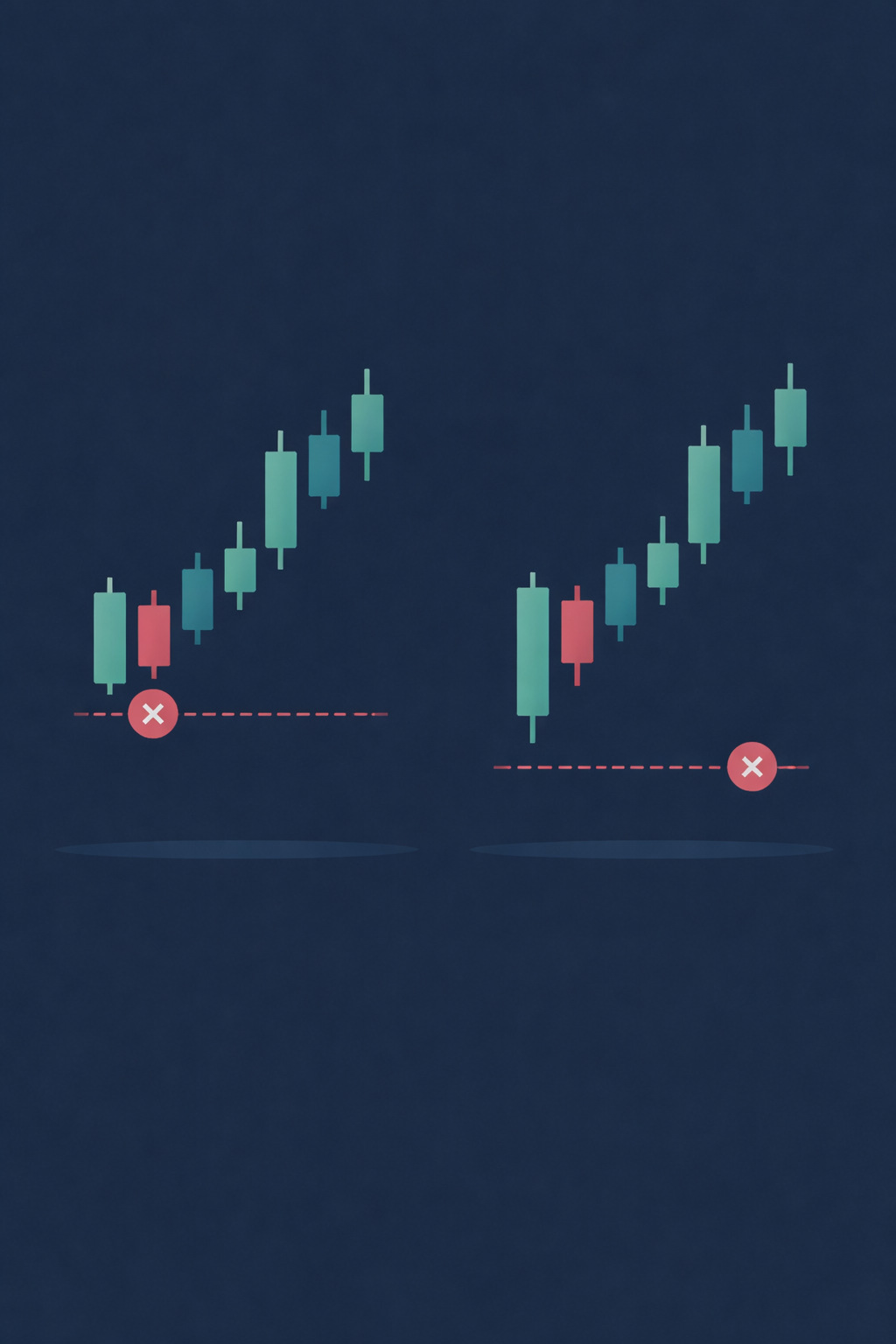
Tight vs Loose Stops
Most traders talk about stop size like it’s a moral issue.
Tight stops get framed as “disciplined.”
Wide stops get framed as “sloppy.”
That framing is wrong.
Stop width is a strategy choice, not a virtue. Tight isn’t automatically better. Wide isn’t automatically worse. They’re simply different trade structures—with different skill demands, different win rates, and different failure modes.
The core truth: tighter stops demand more precision
A tighter stop generally requires more skill.
As the stop gets tighter, the trade’s success depends more and more on near-perfect timing and clean execution. You’re asking the market to behave immediately in your favor, and you’re giving it very little room to breathe.
That can be a valid style—if you’re good at it.
But if you’re struggling, the most practical adjustment is often the simplest:
Widen the stop. Not forever. Not because you “deserve” it. Because you’re currently not surviving the noise.
Probability doesn’t care about your opinion
Options pricing models have a simple lesson: the closer a level is, the more likely price will touch it.
Stops are levels. The tighter your stop is, the more probable it is that normal movement will tag it—regardless of whether your larger thesis is right.
Edge, tactics, and skill can skew outcomes over time. But you can’t escape the baseline reality: close levels get hit more often.
This is why “I was right but got stopped” is such a common sentence.
Sometimes you were right.
And sometimes your stop was sitting exactly where price naturally travels.
Stop width is inseparable from stop placement
There’s a difference between a “tight stop” and a “random stop.”
A stop that’s tight and correctly placed behind a clean structural invalidation or a quick exit based on shifting orderflow can be safer than a wider stop placed in a meaningless location.
So the question isn’t just:
“How tight is my stop?”
It’s also:
“Is my stop actually at the point that proves me wrong?”
Match your stop style to your reason for entry
This is the part traders ignore.
Your stop should match the kind of reason you entered in the first place.
Think about it like Warren Buffett: he holds a company until the reason for owning it no longer exists.
Trading is the same. If your entry rationale is fragile and short-lived, your stop behavior should reflect that.
- •If you entered because of a short-term orderflow signal, you should generally be more inclined to exit quicker/tighter. That signal can change rapidly, and if it flips, your reason for being in the trade is gone.
- •If you entered because of a large structural condition (example: a meaningful failure probe on a 4-hour candle creating a clear excess), you shouldn’t use the same stop style as the micro-signal trader. Your thesis is bigger, slower, and usually requires more room.
A lot of “bad trading” is simply a mismatch:
- •long-term thesis, short-term stop behavior
- •short-term signal, long-term stop behavior
The tradeoff: R/R amplification vs win rate support
Tight stops:
- •Pros
- •Can create big R/R amplification (your invalidation is close, upside is far).
- •Allow you to size up while keeping risk “the same,” because the invalidation point is closer.
- •Cons
- •Typically lower win rate even if your entry/timing skill is high.
- •Easier to get tagged by normal movement.
- •More sensitive to execution friction (slippage, spread, fast tape).
Wide stops:
- •Pros
- •Less demand on precision timing.
- •Can survive noise and natural rotations.
- •Often improves win rate (assuming the entry rationale actually supports it).
- •Cons
- •Usually lowers average R/R unless targets or structure expand.
- •If you don’t adjust size correctly, risk quietly balloons.
- •Can enable vague thinking (“it’ll come back”) if the thesis isn’t clearly defined.
A common trap: “tight stop” as ego
A lot of traders keep stops tight for the wrong reason:
They want to feel skilled.
They want to feel precise.
They want to feel “pro.”
They want to (even if subconsciously) size up and make more, quicker.
If your stop strategy is mostly a self-image strategy, it will cost you money.
Reality check: If you’re constantly in “good ideas” but can’t stay in them long enough to get paid, that isn’t bad luck. It’s either:
- •a skill gap in entry timing/placement, or
- •a mismatch between your entry rationale and your stop tactics
Practical takeaway: use your reviews to tell you the truth
Do the work. Know your stats. Do thorough daily, weekly, and monthly reviews.
Here are the kinds of questions that actually matter:
- •Is my win rate dropping when I tighten stops?
- •Am I frequently right on direction, but getting stopped before the move pays?
- •Am I repeatedly getting tagged at obvious liquidity points?
- •Am I using a short-term stop style on a longer-term thesis (or vice versa)?
If you’re often in good ideas but can’t survive the noise, check the ego.
Widen the stop for a while. Adjust size appropriately. Watch what happens to your P&L and your trade quality. Then reassess from data, not vibes.
The point
Stop width isn’t “disciplined” or “undisciplined.”
It’s a tool. It's a strategy choice. It's a risk management tool that should fit the overall system.
Choose it based on:
- •what you’re actually trading (signal vs structure),
- •where your real invalidation is,
- •the volatility and noise of the environment,
- •and what your own stats say you can execute consistently.
If you match stop style to entry rationale—and you’re honest with your review work—this topic gets a lot less emotional and a lot more profitable.